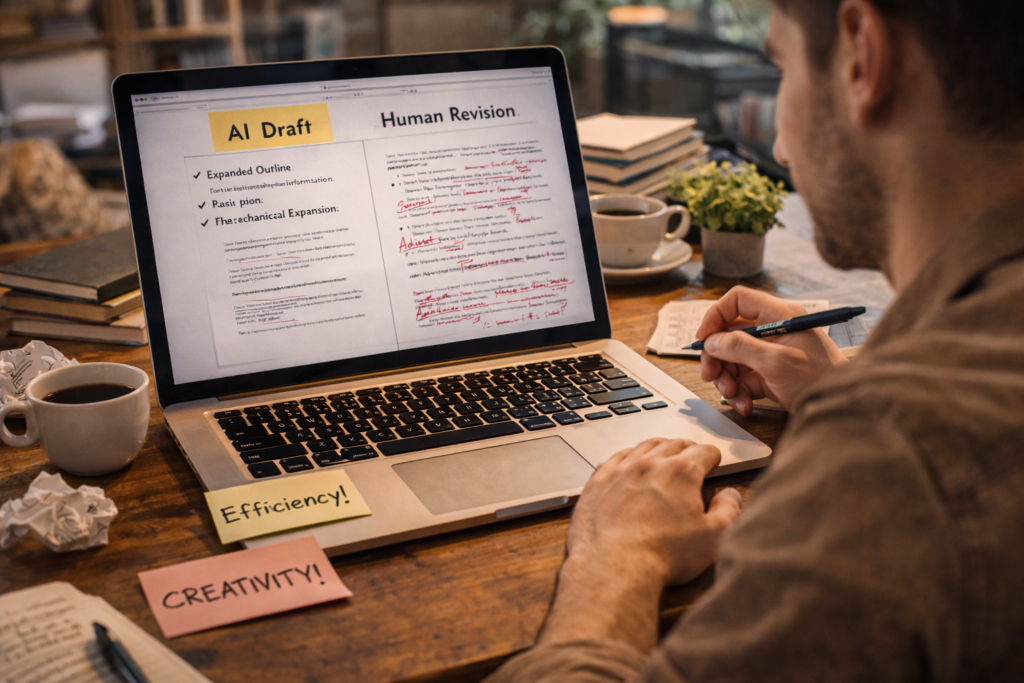
When I first started using AI for long-form writing, my motivation was practical rather than philosophical. Producing consistent 1,500-word articles requires time, energy, and focus, and much of that effort is spent on repetitive expansion rather than original thinking. AI promised relief from that burden. What I did not anticipate was how easily efficiency could begin to override creativity if boundaries were not clearly defined.
My understanding of this balance matured through trial, mistakes, and reflection, as well as by observing how other experienced writers frame the problem inside Humanize AI workflows . The key lesson was not about using AI more cleverly, but about deciding where human creativity must remain protected. Long-form content exposes weak thinking very quickly, and no amount of automation can compensate for a lack of intent.
Why Efficiency Becomes Dangerous Without Limits
Efficiency feels productive because it produces visible output. Pages fill up quickly. Deadlines feel easier to meet. However, efficiency alone does not guarantee value. When AI handles too much of the creative process, content becomes uniform. Articles read smoothly but leave no lasting impression.
I noticed this pattern in my own work. The more I leaned on AI to complete ideas instead of expanding them, the less ownership I felt over the final piece. The writing sounded acceptable, but it no longer sounded like me. Creativity had been quietly replaced by convenience.
This is where many writers get stuck. They equate speed with improvement. In reality, past a certain point, speed reduces depth. Long-form content cannot survive on polish alone. It needs perspective.
Creativity Depends on Friction
Human creativity does not emerge from comfort. It comes from friction. It comes from questioning an idea, rethinking an assumption, or sitting with uncertainty longer than is efficient. AI is designed to eliminate friction. That makes it extremely useful but also potentially harmful if left unchecked.
When I allow myself time to wrestle with a topic before drafting, the article develops a clearer point of view. When I skip that struggle and let AI handle everything, the article becomes informative but forgettable. Creativity requires resistance, and resistance must be preserved intentionally.
Balancing AI efficiency with human creativity means recognizing which parts of the workflow benefit from friction and which parts benefit from speed.
Where AI Adds Real Value
AI performs best when the task is mechanical expansion. Once I have decided what I want to say and how I want to say it, AI can help fill in details, transitions, and explanations quickly. This saves time without interfering with creativity.
I typically use AI to generate a first draft based on my outline and research notes. I expect repetition, neutral phrasing, and cautious explanations. At this stage, none of that is a problem. The draft exists to reduce workload, not to establish voice.
What matters is that AI never determines the structure, the argument, or the emphasis. Those decisions define meaning, and meaning remains a human responsibility.
Where Human Creativity Takes Over
The moment the first draft exists, efficiency stops being the priority. From that point on, creativity and judgment lead the process.
I rewrite introductions entirely because introductions set expectations. AI introductions often explain the topic. Human introductions frame a perspective. That difference affects how every paragraph that follows is read.
I reshape conclusions so they resolve ideas rather than summarize them. I remove sections that do not earn their place, even if they are well written. These choices are creative acts, not technical ones.
This handoff between AI and human effort reflects the thinking behind From AI draft to human content. Drafting is automated for efficiency. Writing remains human for authenticity.
Why Creativity Cannot Be Optimised Like a Workflow
One of the most common mistakes I see is treating creativity as something that can be optimized the same way processes are optimized. Creativity does not scale linearly. It depends on mood, context, experience, and curiosity.
AI is consistent. Humans are not. That inconsistency is not a weakness. It is the source of originality. When content becomes too consistent, readers sense that something is missing.
By keeping creative decisions human-led, variation remains natural. Some articles become reflective. Others are more direct. That variation builds trust because it reflects real thinking rather than a formula.
Tone Is the Result of Editing, Not Instructions
Many writers attempt to preserve creativity by refining prompts. They ask AI to sound more conversational, more opinionated, or more personal. While this can help at the surface level, it does not solve the core problem.
Tone is not a setting. It is a series of decisions. When to soften a statement. When to be direct. When to admit uncertainty. These decisions happen during editing, not generation.
When I edit AI drafts myself, I am actively shaping tone line by line. This process cannot be rushed without consequences. Creativity lives in those small decisions.
How Efficiency Supports Creativity When Used Correctly
Used correctly, AI actually protects creativity. By handling repetitive expansion, AI frees mental energy for thinking and judgment. I am no longer exhausted before editing begins.
Efficiency becomes supportive rather than dominant. AI handles volume. I handle meaning. That division of labor is sustainable.
This balance allows me to produce long-form content consistently without burnout. Creativity survives because it is not being asked to perform mechanical work.
The Problem With Overly Smooth Writing
AI-generated text often feels overly smooth. Transitions are polite. Arguments progress neatly. Nothing feels sharp. Smoothness is comfortable, but it is rarely memorable.
When I edit, I deliberately reintroduce edges. I shorten sentences. I challenge assumptions. I let some ideas feel unresolved. These choices make the writing feel human because humans do not communicate in perfect arcs.
Long-form content benefits from texture. Readers stay engaged when the writing reflects real thought rather than polished neutrality.
Why Long-Form Content Exposes Weak Balance
Short content can hide shallow thinking. Long-form content cannot. Over 1,500 words, repetition becomes obvious. Vague ideas lose credibility. Lack of direction frustrates readers.
This is why balancing efficiency and creativity matters most in long articles. AI can help you reach length quickly. Only human creativity can justify that length.
Every section must earn its place. That evaluation is a human task.
Measuring Success Beyond Speed
I no longer measure success by how quickly an article is produced. I measure it by how readers respond over time. Do they stay on the page? Do they reference specific points? Do they return for more?
Human-led long-form content performs better on these measures because it feels intentional. It respects the reader’s time and intelligence.
Efficiency without creativity may look productive on the surface, but it rarely builds lasting value.
Common Mistakes That Undermine Creativity
One of the most damaging habits is letting AI revise its own drafts repeatedly. Each pass removes individuality. The writing becomes smoother and less distinctive.
Another mistake is skipping manual outlining. When AI controls structure, creativity is constrained from the beginning.
Finally, rushing publication undermines everything. Creativity needs space to surface. Speed should support quality, not replace it.
How This Balance Changed My Work Permanently
Once I accepted that efficiency and creativity serve different roles, my workflow stabilized. I stopped trying to force AI to think like a writer and stopped fearing that it would replace my voice.
AI became a drafting assistant. I became the author again.
This clarity removed frustration and improved consistency. Articles felt more personal without taking more time to produce.
Final Thoughts
Balancing AI efficiency with human creativity in long-form content is not about compromise. It is about design. When each stage of the process has a clear owner, quality improves naturally.
AI should handle repetition and expansion. Humans should handle meaning, judgment, and voice. When that balance is respected, long-form content becomes both scalable and authentic.
This is why discussions inside Humanize AI workflows resonate with writers who care about quality. They recognize that creativity does not disappear when AI enters the process. It disappears only when humans step out.
Used thoughtfully, AI makes creativity sustainable rather than optional. That is the balance worth maintaining.