Introduction
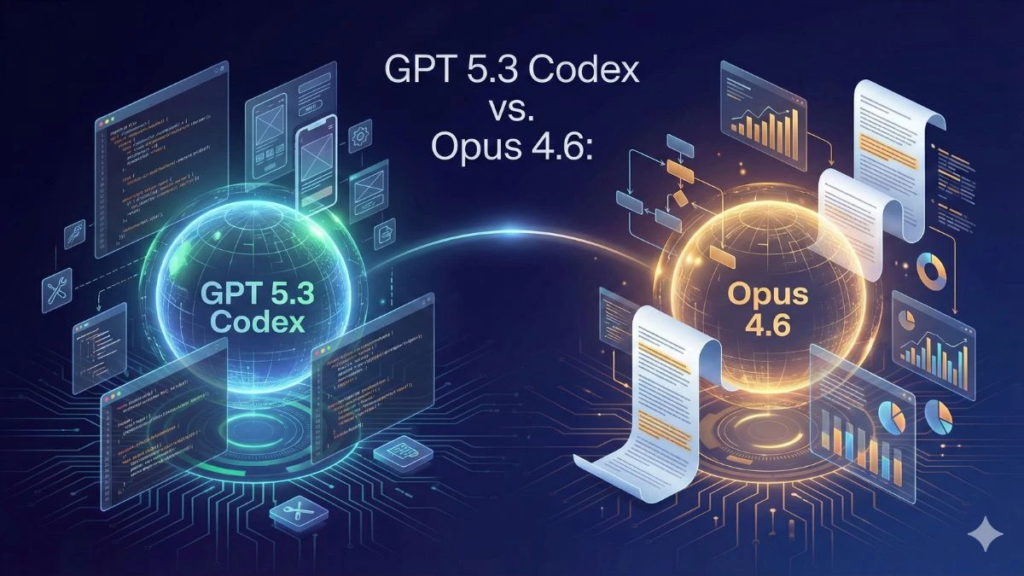
In 2026, coding with the help of artificial intelligence has become more common than ever. Developers now rely on AI models to write, debug, and optimize code faster and smarter. Among the top choices in AI for coding are GPT-5.3 Codex and Claude Opus 4.6. Both models offer unique features, and understanding their capabilities is crucial for developers, students, and tech enthusiasts who want to choose the right tool. This article will explore their strengths, weaknesses, and real-world applications, helping you make an informed decision.
Overview of GPT-5.3 Codex
GPT-5.3 Codex is an advanced AI model designed specifically for coding. It builds on the earlier versions of GPT but adds new layers of intelligence, making it more accurate in understanding programming languages. The model can generate code snippets, explain algorithms, and even debug complex programs. One of the most impressive features of GPT-5.3 Codex is its ability to understand context, which allows it to write code that aligns with the developer’s intentions. This is particularly useful for beginners who may not be familiar with certain syntax or best practices.
Another advantage of GPT-5.3 Codex is its versatility. It supports multiple programming languages, including Python, JavaScript, Java, and C++, and can adapt to different coding styles. Developers can integrate it into IDEs or use it through cloud platforms, making it accessible for individual programmers and large teams alike. While the AI is powerful, it still requires human oversight, especially for complex projects, as it may occasionally produce minor errors or inefficient solutions.
Overview of Claude Opus 4.6
Claude Opus 4.6 is another AI model that has gained popularity in the coding community. It is part of the Claude AI family, which focuses on combining natural language understanding with code generation. Unlike GPT-5.3 Codex, Claude Opus 4.6 emphasizes safety and reliability, reducing the risk of generating incorrect or harmful code. It is particularly strong in tasks that involve structured programming, documentation, and automation.
Claude Opus 4.6 also integrates well with team workflows. It can review code, provide suggestions, and even automate repetitive coding tasks. This makes it a great tool for professional developers who need consistent performance and fewer errors. Interestingly, the Claude AI series also includes Claude Sonnet 5, which focuses more on creative problem-solving and experimenting with unconventional coding approaches. Developers who need innovative solutions often use Claude Sonnet 5 alongside Claude Opus 4.6 for best results.
Comparison: Accuracy and Speed
When it comes to accuracy, both GPT-5.3 Codex and Claude Opus 4.6 perform well, but in different ways. GPT-5.3 Codex excels at producing fast, functional code with a high level of contextual understanding. It is ideal for developers who want rapid prototyping or need assistance in complex algorithms. Claude Opus 4.6, on the other hand, focuses on precise and reliable code, which makes it better for large-scale projects where errors can be costly.
In terms of speed, GPT-5.3 Codex generally works faster due to its optimized processing of multiple programming languages. Claude Opus 4.6 may take slightly longer, but the trade-off is fewer mistakes and better integration with team-based development workflows. Choosing between speed and reliability depends on the project’s needs, but both models provide significant advantages over traditional coding methods.
Ease of Use and Learning Curve
For beginners, GPT-5.3 Codex is slightly easier to start with. Its natural language prompts allow users to describe what they want in plain English, and the AI translates that into code. This is helpful for students, hobbyists, or developers learning a new language. Claude Opus 4.6 requires a bit more familiarity with programming concepts but offers robust guidance once the user becomes comfortable. It also shines in helping teams maintain coding standards, which is crucial in professional settings.
The integration of Claude Sonnet 5 further enhances learning. Its creative approach can help users understand not only how to code but also why certain coding strategies work better than others. By experimenting with Claude Sonnet 5 alongside Claude Opus 4.6, developers can develop both technical skill and innovative thinking.
Real-World Applications
Both AI models have a wide range of applications. GPT-5.3 Codex is particularly effective in rapid software development, app creation, and solving algorithmic challenges. It can also assist in automating repetitive tasks like generating boilerplate code or unit tests. Claude Opus 4.6 is often used in enterprise-level software development, code review, and collaborative coding environments where consistency and accuracy are critical.
For educational purposes, GPT-5.3 Codex is excellent for learning programming fundamentals, while Claude Opus 4.6 provides deeper insights into best practices, optimization, and team collaboration. Together with Claude Sonnet 5, it creates a comprehensive toolkit for both learning and professional development.
Conclusion
Choosing the best AI model for coding in 2026 depends on your priorities. If speed, flexibility, and rapid prototyping are important, GPT-5.3 Codex is the best choice. For accuracy, team collaboration, and professional-grade software development, Claude Opus 4.6 is more suitable. Integrating Claude Sonnet 5 with Claude Opus 4.6 can further enhance creativity and problem-solving skills. Ultimately, both AI models represent the next generation of coding assistance, making programming faster, smarter, and more accessible than ever.